Leading the redesign that secured Business Kitz £3M
Leading a full platform redesign that rebuilt trust with clients and investors, turning a stalling legaltech product into one that raised over £3M and grew from 150 to 1,000+ active users.
- Problem
- A 2021 legaltech product had stalled. Poor UX broke trust with law firms and clients, and investors had pulled back.
- Role
- Lead Product Designer, end to end, working with the CEO, CPO, sales and investors.
- What I did
- Led a full platform redesign connecting user needs, product direction and commercial goals.
- Outcome
- Helped raise over £3M and grew from 150 to 1,000+ active users.
- Client
- Business Kitz
- Role
- Lead Product Designer
- Timeline
- 2025
- Outcome
- £3M raised · 150 → 1,000+ users

Overview
Business Kitz works with some of the biggest law firms and listed companies in Australia and the UK, so the product knows the agreements, policies and systems that large businesses need to run.
The first version launched in 2021 and hadn't been touched since. It was built to help lawyers and HR managers write policies and agreements and to keep all those documents in one place. The problem was that the experience hadn't kept up with what the business or its users needed.
I led the redesign from start to finish. My job wasn't just to make the screens look better. It was to bring together three things, what users needed, what made sense for the product, and what the business needed commercially, and use design to connect them. That meant working with the CEO and CPO on direction, with clients and the sales team on what was breaking trust, and with investors who needed to see the product was worth backing again.

The problem
Over the previous two years, Business Kitz had lost the trust of law firms and clients. The old design and limited features made everyday tasks slow and frustrating, and that had a real cost: investors pulled back, which put the company's future at risk.
The homepage showed the problem clearly. Users told us it was confusing, didn't make it clear what to do next, and didn't point them to the parts of the platform they actually used. Many had stopped using it at all.
I treated this as both a product problem and a business problem. Every usability win had to turn into something the CEO, CPO and investors could feel: faster tasks, more confidence from clients, and a strong story for the next round of funding.

Approach and strategy
The work was done in steps, but it started with a proper discovery and research phase across the whole platform. My plan had three goals: move fast and show value early to win back investor confidence, work closely with developers so the designs actually shipped, and stick to proper UX instead of surface-level fixes.
Research backed up every decision. I tested the platform with 6 users, interviewed an investor who also used the product to run her own consultancy, and spoke with the Business Kitz sales rep. I did this on purpose so the redesign worked for users, the business and the people selling it.
To show value early and lower the risk of the rebuild, I split the redesign into three phases, each focused on a high-impact area: the homepage, the document library, and the profile pages.
Phase 1: the homepage
The homepage was the way in, so it went first. The research told a clear and consistent story. The investor felt the UI was old and that the homepage and nav bar did the same job, just pointing elsewhere, with nothing you could actually act on. The 6 users were frustrated by how many clicks it took to reach templates and files, and some found features they never knew existed. The sales rep kept hearing the same complaints from clients.
From this I set clear goals: rework the layout and navigation, bring more profiles and documents onto the homepage so users could actually do things from it, and give the whole thing a UI refresh built on shared components. We then ran a few rounds of ideas, voting and talking them through with users until we had two sketches, which we tested with both users and the investor.
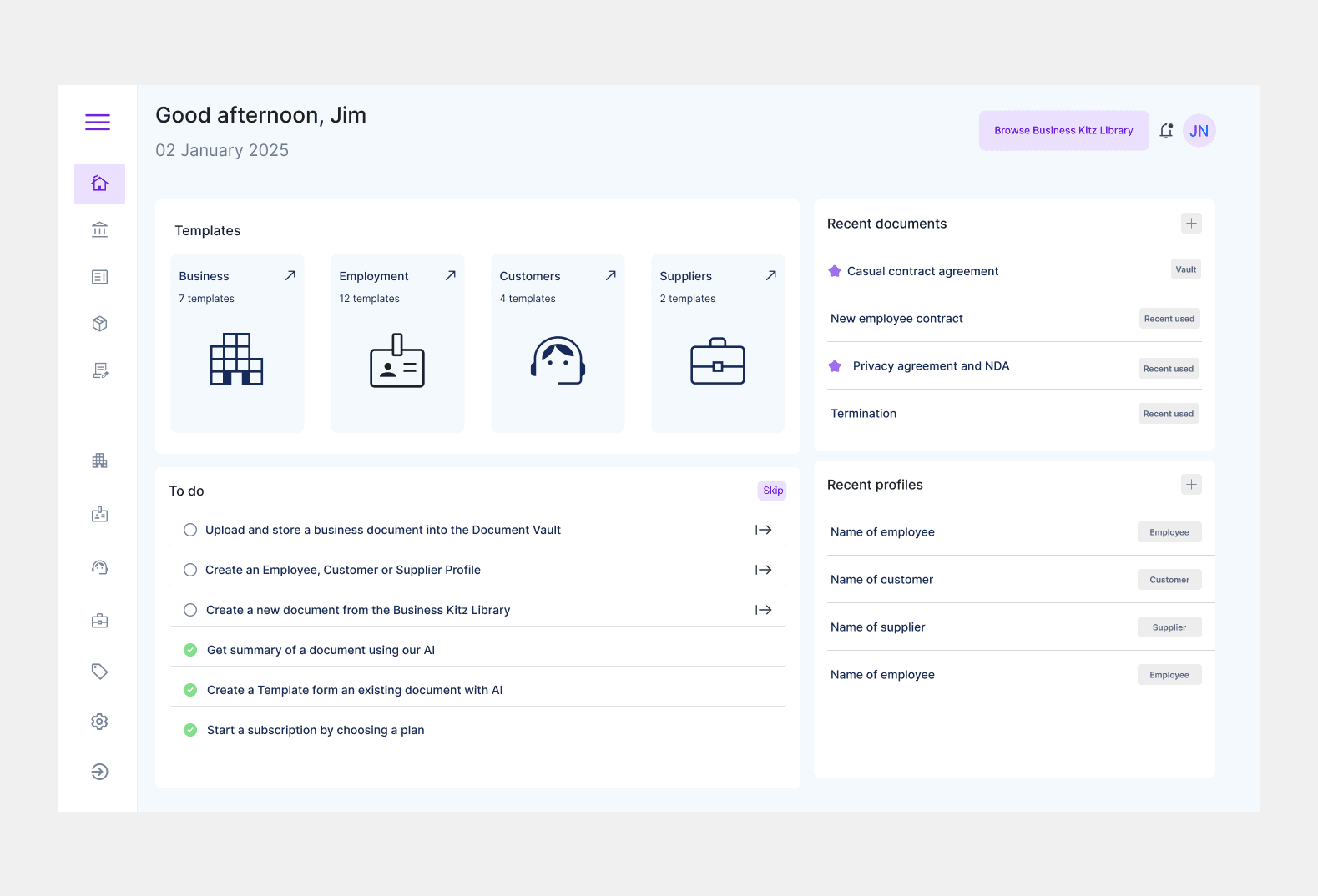
The result was a homepage built around getting things done: templates, recent documents, recent profiles and a simple to-do list that tells users exactly what to do next.


Phase 2: document library
The document library was where the real work happened, and it was painful to use. The investor said it took ages to move from one document or template to another, and that splitting templates by country got in the way rather than helping. Five of the six users wanted to see their documents straight away, and again pointed out that the UI had no clear order to it.
I set goals around bringing the Business Kitz library and the client's own library into one view, showing as many documents as possible, and matching the wider UI refresh. I mapped a user flow for creating, editing and managing documents, including the path to make a new document from either the BK library or the user's own, then worked it down to two options and tested them.
The new library puts documents and templates side by side, shows the details and actions for each one, and gets rid of the dead ends users kept running into.


Phase 3: profiles
The last phase was the profile pages. I'll show the Employee profile here, since the customer and supplier profiles use the same design and flow.
Users found it hard to edit information or add documents and templates to a profile, and some couldn't upload contacts in the first couple of clicks. The investor wanted to look through details without being forced through everything else, and the sales rep said people were confused about which fields were required.
The goal was one profile that links cleanly to documents, contacts and details, with much easier editing. I mapped the profile flow (Details, Documents, Contacts and Notes) and designed one profile that brings employment, qualifications, emergency contacts and linked documents together in a single, easy-to-edit view.


Outcome
After launch in April, Business Kitz raised over £3 million and grew from just 150 to over 1,000 active users. That was a big jump in usage and, just as important, in investor confidence. The redesign I led was a key part of that raise: it gave the business a real, working product to show investors and clients.
Users said the new design made it much easier to create and manage documents. I kept the work efficient and developer-friendly throughout, and presented the new designs directly to both investors and clients.
In a separate but related project, I added generative AI to the policy and agreement creation flow. That taught me a lot about guiding AI interactions and designing more human, conversational UX.
Reflection
This is the project where I stopped seeing myself as someone who just redesigns screens and started working as a lead, mixing product thinking, design and business strategy, and using each one to support the others. Standing up for users wasn't separate from the business goal. Clearer, faster journeys were exactly what won back client trust and helped secure the funding.
Working closely with the CEO, CPO, clients, the sales team and investors taught me how to explain design decisions in the way each of them cared about, while keeping the user at the centre.